
Spring failure can happen suddenly and may create a sharp noise even when the door is not actively being operated.
Coquitlam Garage Door Spring Repair
Garage Door Spring Repair in Coquitlam, BC
A broken garage-door spring can leave the door unusually heavy, difficult to move, uneven or unable to open normally. Spring repair should restore the correct counterbalance and check the cables, movement and opener for related strain.
If a spring is visibly broken, a cable is displaced or the door is crooked or unstable, stop normal operation. Do not loosen spring hardware or attempt to reset loaded cables yourself.
- Broken torsion & extension springs
- Heavy or uneven doors
- Spring, cable & balance checks
- Opener-strain assessment
Quick Answer
What happens when a garage-door spring breaks?
The spring system can no longer provide its intended counterbalance. The door may become much heavier, stop opening normally, move unevenly or cause the automatic opener to struggle. A visibly failed spring should be treated as a repair problem rather than routine maintenance.
Broken Spring Warning Signs
Does this look like a garage-door spring problem?
Several garage-door problems can create similar symptoms, so use these signs as a reason to inspect the counterbalance system rather than as a substitute for diagnosis.
The spring system offsets much of the door's weight. A major change in apparent weight can point toward lost counterbalance.
The opener may be reacting to a door that is no longer properly counterbalanced rather than suffering a motor failure of its own.
Uneven travel can involve springs, cables or another mechanical problem and should be assessed before the door is operated again.
A gap in an exposed torsion spring can be a clear sign that the spring has broken.
Cable position can change when the counterbalance system fails. Do not pull, wind or reconnect loaded spring-and-cable hardware yourself.
Spring Safety
Stop normal operation when the spring system is visibly compromised.
Garage-door springs, cables and connected hardware can store substantial mechanical energy. Repeatedly testing a damaged system does not make it safer.
Do not keep cycling the door.
If a spring is visibly broken or the door suddenly becomes unusually heavy, stop routine opener operation.
Do not loosen loaded components.
Spring anchors, winding hardware and other counterbalance components should not be casually adjusted or dismantled.
Do not reset a loose cable yourself.
Lift cables work with the spring system and can remain associated with substantial tension and door weight.
Keep clear of a crooked door.
If the door is hanging unevenly or appears unstable, keep people and vehicles out of its path until it is assessed.
Know the Spring System
Torsion and extension springs perform the same core job differently.
Repair begins by identifying the spring system already installed rather than assuming every residential door uses the same configuration.
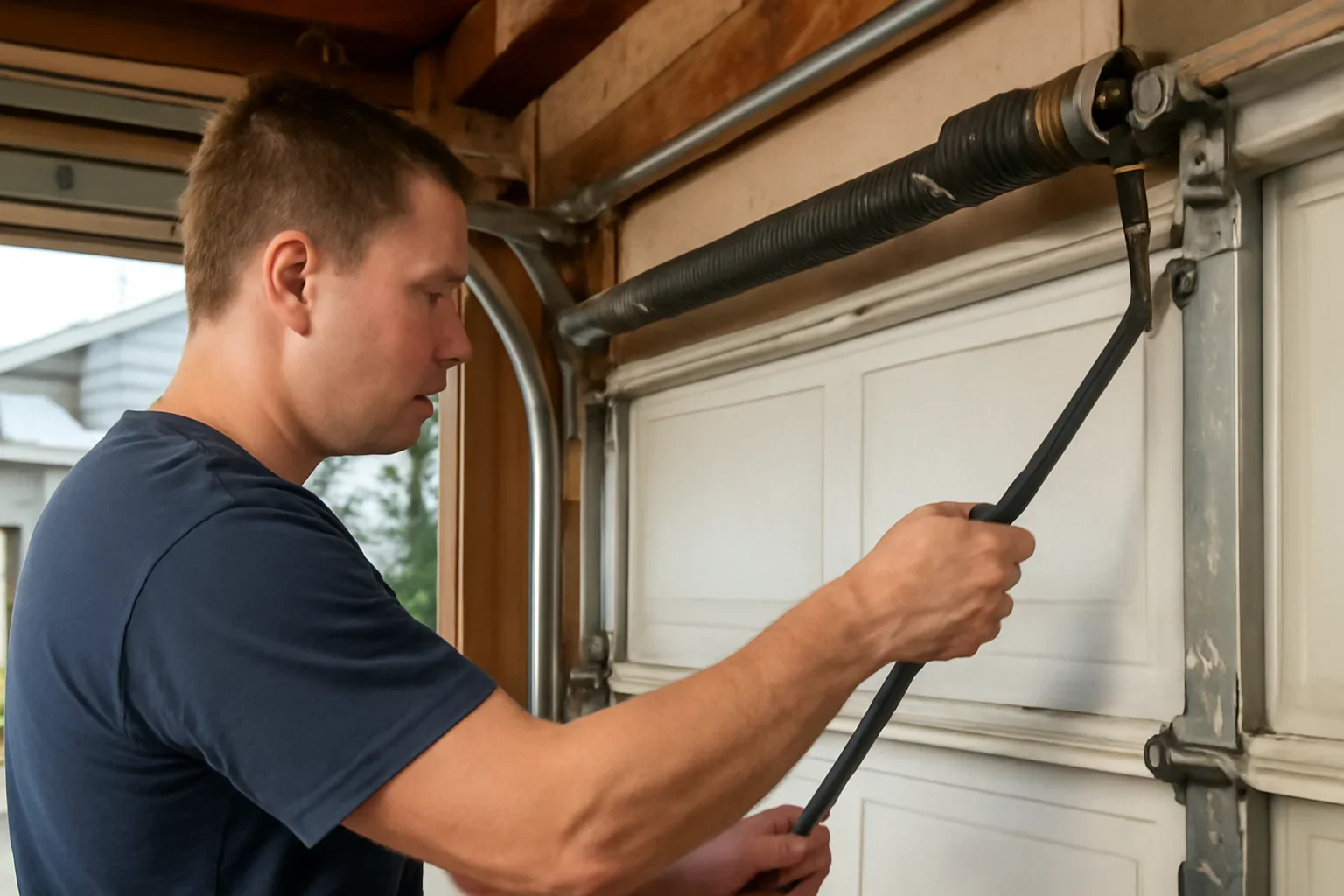
Springs mounted around a shaft above the opening.
A torsion system stores rotational energy on a shaft and transfers lifting force through drums and cables.
- Usually positioned above the garage-door opening.
- May use one or more springs depending on the system.
- Spring, shaft, drums and lift cables work together.
- A broken exposed spring may show a visible gap in the coil.
Springs positioned alongside the horizontal tracks.
Extension springs stretch as the door closes and work with pulleys, cables and appropriate safety containment.
- Typically installed beside the horizontal track area.
- Stretch and contract as part of door operation.
- Safety cables are an important part of applicable extension-spring systems.
- A damaged extension spring should not be treated as casual DIY maintenance.
More Than the Spring
Lift cables
Drums / pulleys
Rollers & tracks
Door sections
Opener
Final operation
Cable, Roller & Track Repair
A spring failure can affect the rest of the lifting system.
Spring repair should account for the components that share the lifting load and guide the garage door. A spring can be the primary failure without being the only condition that needs attention.
Check for visible fraying, displacement, kinks or damage rather than assuming the cables remained unaffected.
Cable-routing and winding components should be reviewed when cable position or door movement changes.
Crooked or interrupted travel can involve roller or track conditions in addition to a spring failure.
Damage or changes to the physical door can affect its weight and the spring specification required to counterbalance it.
Check whether the opener was repeatedly asked to move a heavy or poorly counterbalanced door.
The repaired system should rely on correct counterbalance rather than asking the automatic opener to compensate for improper spring performance.
Coquitlam Service Context
Property conditions affect service access, not the spring diagnosis.
Coquitlam includes established homes, hillside properties and newer multi-unit housing. Those details can change garage access and coordination, while spring failure should still be diagnosed from the actual door.
Share unusual access conditions.
A steep driveway, retaining walls or restricted approach can affect where vehicles and service equipment can safely be positioned.
Identify the installed system.
Older and newer garages can use different spring, track and opener arrangements. Photos of the complete interior setup can provide useful context.
Clarify access and authorization.
Strata, rental and other managed properties can require owner or property-management coordination when repair access or approval is involved.
Keep site conditions separate.
Runoff or water around the driveway can affect access or threshold conditions, but it should not be presented as the reason a spring failed.
Spring Selection
A replacement spring has to match the door it is balancing.
Spring selection should not be based only on visual similarity. The door and installed counterbalance configuration determine what replacement setup is appropriate.
The repaired spring system needs to counterbalance the actual door rather than a generic residential-door assumption.
Size, insulation, glazing and section construction can influence the overall weight that the spring system must manage.
Identify torsion, extension or another compatible counterbalance arrangement before selecting replacement components.
Single-spring and multi-spring systems should be evaluated according to the installed door rather than treated as interchangeable.
Cables, drums, pulleys and related counterbalance components need to remain compatible with the completed setup.
Two Common Questions
Consider the complete spring system and the opener after a failure.
One broken spring can raise two separate decisions: what should happen with the other spring in a multi-spring system, and whether the opener was strained while the door was poorly counterbalanced.
What if the door has two springs?
When a door uses a matched two-spring configuration, assess the pair rather than looking only at the visibly broken spring.
- Confirm the installed spring configuration.
- Review the condition of the remaining spring.
- Follow the requirements for the particular door and spring system.
- Leave the completed door properly counterbalanced.
Do not assume the same replacement approach applies to every single-spring and multi-spring garage door.
Did the broken spring damage the opener?
Not necessarily. A failed spring can make the door much harder for the opener to move, so apparent motor weakness may begin with the mechanical door.
- Note whether the opener was repeatedly operated after the failure.
- Listen for new motor or drive noise.
- Restore correct door counterbalance first.
- Diagnose remaining opener problems separately.
Spring Repair Process
Restore the counterbalance, then verify the connected system.
Spring service should begin with the actual door and installed counterbalance system rather than assuming a universal replacement part.
Confirm the spring system
Identify spring type, number of springs and the symptoms that led to the service request.
Check connected hardware
Review cables, drums or pulleys, rollers, tracks and related components for additional problems.
Determine the spring setup
Match the repair to the door's weight, construction and intended counterbalance configuration.
Restore the spring system
Complete the required spring work using the appropriate procedure for the installed system.
Review door and opener operation
Confirm the repaired door operates appropriately and identify any separate opener or hardware problem that remains.
What If It Is More Than the Spring?
Use the service path that matches the complete condition.
Spring failure can be the main problem while another component also needs attention. Route the follow-up work by what is actually damaged.
01
General garage-door repair
Use broader repair when tracks, rollers, sections or other mechanical components are also damaged.
02 Cable, roller or track damageUse the component-repair page for frayed cables, displaced cables, damaged rollers or track problems.
03 Opener problems remainUse opener repair when controls, motor behaviour or powered travel remain abnormal after the door's mechanical condition is addressed.
04 Preventive maintenanceOnce an active failure is resolved, maintenance is the better route for routine inspection and ongoing condition checks.
Before You Request Service
Describe what changed rather than trying to measure the spring.
You do not need to touch the spring or cable system. A clear description and safe photos usually provide a better starting point.
- What happened? Mention a loud snap, sudden heavy door, crooked travel or a failure to open normally.
- Door position Tell us whether the door is closed, open, partly open or visibly uneven.
- Opener behaviour Describe whether the opener runs, strains, clicks or no longer moves the door.
- Visible damage Note a spring gap or loose cable only if it can be observed safely without climbing or handling the system.
- Access impact Say if a vehicle is trapped or the garage cannot be secured normally.
- Property access Mention a steep driveway, gate, strata coordination or other conditions that could affect service access.
Spring Repair Pricing
What affects garage door spring repair cost in Coquitlam?
The repair scope depends on the actual spring system and door. A useful estimate needs more detail than simply knowing that a spring has broken.
Spring type and configuration
Torsion, extension and multi-spring arrangements can involve different components and repair procedures.
Door specification
Door size, construction and weight affect the appropriate counterbalance setup.
Number of springs involved
A multi-spring system can create a different repair scope from an appropriate single-spring arrangement.
Related cable or hardware damage
Frayed cables, damaged drums, rollers or tracks can require separate repair work.
Additional opener work
Any opener fault that remains after proper door balance is restored should be scoped separately.
Spring Repair Questions
Coquitlam garage door spring repair FAQs
Direct answers to the questions that matter when a garage-door spring has broken or the door suddenly behaves differently.
How can I tell if my garage door spring broke?
Common signs include a loud snap, a door that suddenly becomes much heavier, an opener that cannot lift normally, uneven travel or a visible separation in an exposed torsion spring. Similar symptoms can have other causes, so the complete lifting system should still be assessed.
Can I keep using the garage door with a broken spring?
Normal operation should stop when a spring is known to be broken. The door may no longer be properly counterbalanced and continuing to operate it can load the opener and connected hardware abnormally.
Can I replace or adjust a garage door spring myself?
Spring repair is not appropriate casual DIY work. Garage-door springs and connected cable hardware can retain substantial mechanical energy. Do not loosen winding hardware, alter spring tension or reconnect loaded cables without the appropriate tools, training and procedure.
Should both springs be replaced if one breaks?
It depends on the installed configuration. If the door uses a matched two-spring system, the complete pair should be assessed rather than automatically treating the failed spring as an isolated component. The final decision should follow the requirements of the particular door and spring system.
Can a broken spring make the opener look broken?
Yes. A spring failure can leave the door much harder for the opener to move. Restore the door's proper mechanical counterbalance before assuming the opener motor is the primary failure. If powered-operation problems remain, see Coquitlam garage door opener repair.
What if the door is crooked after the spring failed?
Stop normal operation and have the cables, rollers, tracks and spring system checked together. Crooked travel can mean more than the spring alone has been affected. See Coquitlam garage door repair.
How long should a garage door spring last?
There is no single responsible lifespan for every spring. Spring design, rated cycles, door use, setup and operating conditions vary. Use the specification for the actual installed spring system rather than relying on one universal age estimate.
What if the spring failure traps my vehicle or leaves the garage unsecured?
State the access or security problem clearly when requesting service. Do not attempt spring or cable adjustments simply to regain access. If the situation is urgent, use Coquitlam emergency garage door repair and confirm current availability.
Request Spring Repair in Coquitlam
Tell us what changed and where the garage door is now.
Share whether you heard a snap, the door became unusually heavy, the opener is struggling, a spring looks separated or the door is sitting unevenly. Photos are useful when they can be taken without approaching damaged spring-and-cable hardware.
- Current door position
- Loud snap or weight change
- Opener behaviour
- Safe photos if available